
Does a Straight Beat Three of a Kind in Poker Hands?
Does a Straight Beat Three of a Kind in Poker Hands?
Three of a kind is one of those poker hands that feels bigger than it is. The repeating symbols make it easy to recognize at a glance, so many new players overvalue it. A straight is quieter. It can appear through shared community cards, hide behind a messy board, then quietly outrank trips. That gap between what looks impressive and what actually wins is where many beginner Hold’em mistakes start.
The basic rule is simple: a straight beats three of a kind. A straight is five cards in sequence, such as 9-10-J-Q-K. Three of a kind is three cards of one rank, plus two side cards that do not share a rank. The reason this sometimes confuses new players relates to visual attention: humans naturally lock onto repeated symbols, not subtle sequences.
In a study on expertise and visual search, researchers found that skilled observers are better at spotting features that are useful to the task, not just the most visually obvious ones. Poker hand reading works in a similar practical way: the board tells you which details deserve attention first.
Read the Board Before You Admire the Hand
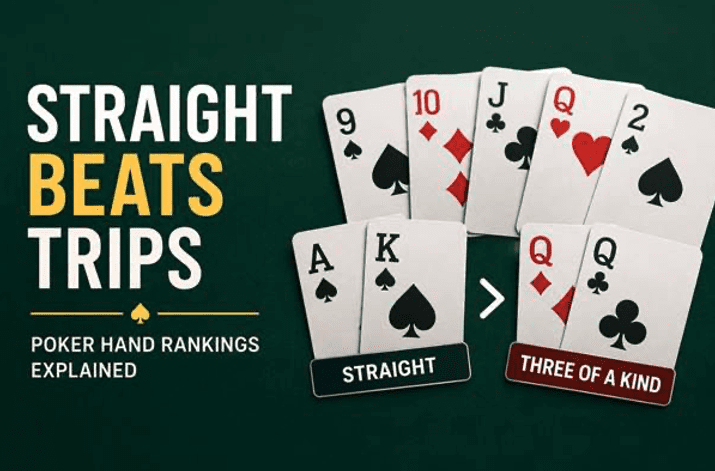
As an example, imagine that the board is:9♠ 10♦ J♣ Q♥ 2♠The first thing to notice is the connected run from 9 through Q. That run means any king completes 9-10-J-Q-K. It also means A-K completes 10-J-Q-K-A, the highest straight available from this board.
Playing on an online site for real money poker exposes you to a wide variety of different poker formats that all share the same basic ranking rules. While hand rankings are stable, different formats change how often certain hands show up and which starting hands are playable. Seeing many examples quickly trains your eye to spot straights and other strong patterns without overrating trips.
Across almost every poker variant, it helps to build a simple habit:
-
- First, identify the best hand that is currently possible using the shared board cards
- Then, look at your private cards and note which ones complete or improve the patterns you see
When you train yourself to start with the board instead of your own hole cards, your hand reading becomes faster and less emotional.
If you want extra practice before sitting in a real game, short puzzle-style situations are very effective. Try to read a hand from beginning to end, then compare your answer with the actual result.
Here is a quick exercise that uses the same board example:
Example: Straight vs Trips on a Connected Board
The board is again:9♠ 10♦ J♣ Q♥ 2♠Three players go to showdown:
-
- Hand A: K♦ 8♦
-
- Hand B: A♠ K♠
- Hand C: Q♦ Q♣
Hand C makes three queens (three of a kind), which looks very strong at first glance. Hand A makes a king-high straight with 9-10-J-Q-K. Hand B makes an ace-high straight with 10-J-Q-K-A. Since a straight beats three of a kind, Hand C is behind both straight hands. Since B’s straight is higher than A’s straight, Hand B wins.
This small puzzle shows why over-focusing on the repeated symbols in trips can be dangerous. The queens are eye-catching, but the real story is the five-card sequence built from the board.
If it helps, you can imagine a simple graphic where the straights are highlighted in a row and the queens are grouped together. Visually seeing the five-card sequence often makes the ranking feel more natural and easier to remember.
The Two Comparisons That Decide the Winner
Most showdown confusion disappears when you break the decision into two layers.
-
- Compare the hand category
A straight beats three of a kind, so any completed straight outranks three of a kind. This is true regardless of card rank: even a low straight beats three aces.
- Compare the hand category
- Compare hands within the same category
This only matters if two players share the same type of made hand. If two players both have straights, the highest card in each straight decides the winner.
In the example above, Hands A and B both have a straight. A uses a king with the board to make 9-10-J-Q-K. B uses both a king and an ace with the board to make 10-J-Q-K-A. The ace-high straight is higher than the king-high straight.
Kickers do not rescue Hand A here, because a straight is already a complete five-card hand. There is no “extra” card left to use as a tiebreaker. Extra side cards only matter in hand types where side cards are part of the final comparison, such as one pair, two pair, or high card.
An Easy Way to Remember the Rule
A simple mental checklist keeps this rule clear and stops three of a kind from tricking you.
-
- Do not start with the hand that feels the most dramatic
-
- Start with the best complete five-card hand the board allows
-
- If the board is connected, always ask what straight is possible before giving trips full credit
- If you can make a straight, check whether your straight is the highest one available
Used consistently, this order keeps the game readable without turning every hand into a math exercise. A straight beats three of a kind because poker ranks complete five-card categories first. An ace-high straight beats a king-high straight because once the category is fixed, the top card breaks the tie.
Strong hand reading is usually not about staring longer at the table. It is about noticing the useful cards first, holding the full pattern in mind, and making comparisons in the right order. That idea fits nicely with broader research on visual decision-making, where clear interpretation depends on matching the display to the judgment you need to make.